1. Put a price on one unit of everything you buy
Take the price on the invoice and divide it by how many units come in the pack. A 5 lb bag of espresso beans at $62.50 holds about 2,268 grams, so one gram costs just under 3 cents. A gallon of whole milk at $4.49 is 3,785 ml. A case of 1,000 hot cups at $92 is 9.2 cents a cup.
Count the cup, the lid and the sleeve. They are easy to leave out, and on a hot drink they come to about 16 cents.
2. Add up one drink
| 12 oz latte | Cost |
|---|---|
| Espresso, 18 g | $0.50 |
| Whole milk, 300 ml | $0.36 |
| 12 oz cup | $0.09 |
| Lid | $0.04 |
| Sleeve | $0.03 |
| Total | $1.01 |
3. Divide by what you charge
At $5.25, that latte costs 19% of its price. The sample shop sets its target at 30%, so the latte is doing its job.
4. Look hard at the drinks that hide a problem
The same shop sells a 16 oz oat milk latte for $6.25. Oat milk costs more than three times as much as whole milk per milliliter, so that drink costs $2.35 to make: 38% of its price. To hit 30%, it would need to sell for $7.85.
The shop sold 245 of them in a week. A 75 cent oat milk charge takes the drink to $7.00 and 34%, and adds about $184 a week at the same sales. That is about $9,500 a year from one line on the menu board.
Chai is the other one to watch. Concentrate is expensive, and the sample chai latte runs 37%.
5. Do it again when a price changes
When your roaster or your dairy raises a price, every drink that uses it moves. Worked out on paper, nobody redoes it. In a spreadsheet, you change one price and every drink updates.
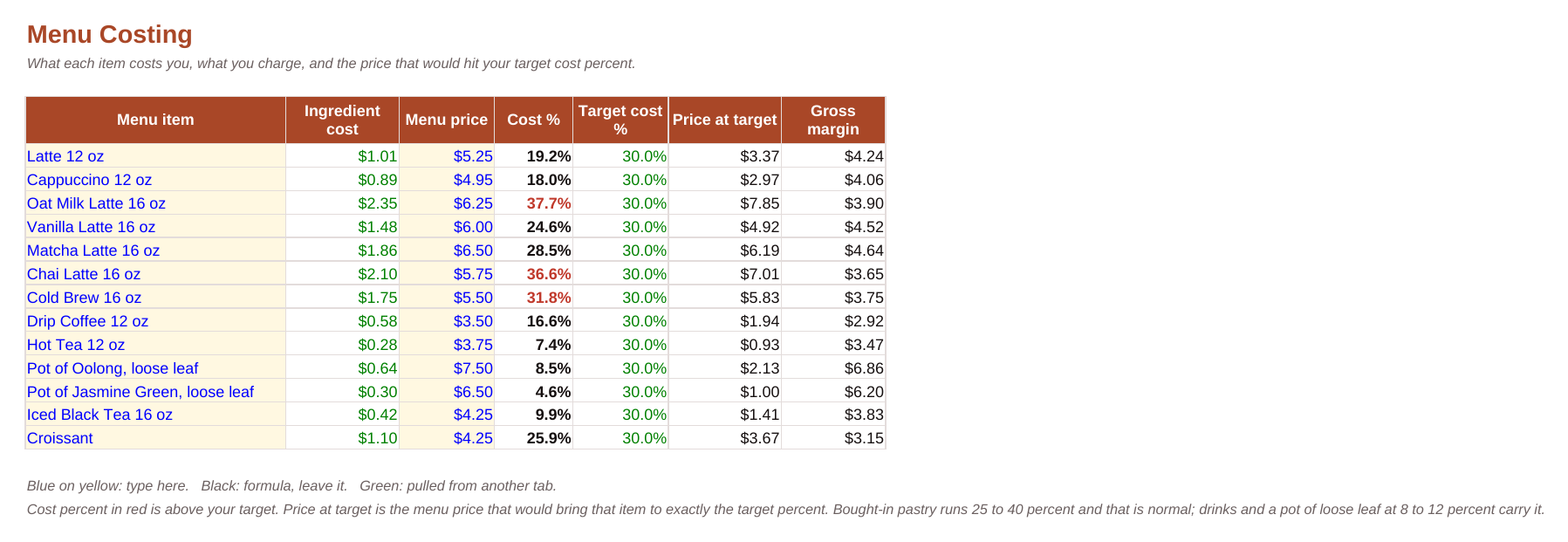
The kit's Menu Costing sheet does this for every drink on your menu with real formulas. Type what you pay and what you charge, and it shows each drink's cost percent, the price at your target, and the margin. It is part of the Daily Numbers workbook in the Tillwhistle kit, $97 once.