1. The formula
Labor cost percent is what you pay for hours on the floor, divided by net sales for the same days. Count wages for everyone who works the floor, including a manager on salary. Then add payroll burden: employer taxes and workers comp. The kit starts burden at 10 percent; use the figure from your payroll provider.
Leave the owner out, unless you pay yourself a wage for floor shifts. Then you count too.
2. Pick a target
Many independent cafes run between 25 and 32 percent. The sample shop holds 28%. Whatever you choose, write it down and use the same number every week, so one week can be compared with the next.
3. Turn the target into dollars for each day
Multiply each day's expected sales by the target. The sample shop expects $1,500 on a Monday, so Monday's labor budget at 28% is $420. Saturday, its busiest day at $2,150, gets $602. The whole week, at $12,250 in expected sales, gets $3,430.
4. Price the schedule you wrote
| Day | Expected sales | Hours | Labor with burden | Labor % | Over (under) budget |
|---|---|---|---|---|---|
| Mon | $1,500 | 25.75 | $499.26 | 33.3% | $79.26 |
| Tue | $1,550 | 25.75 | $497.20 | 32.1% | $63.20 |
| Wed | $1,600 | 21.75 | $401.09 | 25.1% | ($46.91) |
| Thu | $1,650 | 25.75 | $497.20 | 30.1% | $35.20 |
| Fri | $1,900 | 29.75 | $569.80 | 30.0% | $37.80 |
| Sat | $2,150 | 26.25 | $488.81 | 22.7% | ($113.19) |
| Sun | $1,900 | 26.25 | $480.84 | 25.3% | ($51.16) |
| Week | $12,250 | 181.25 | $3,462.94 | 28.3% | $32.94 |
The week lands at 28.3%, close to the target. The days do not. Monday and Tuesday run over 32%, while Saturday sits at 22.7%. The week also carries $28.74 of overtime premium, because one shift lead is scheduled for 42.75 hours.
5. Move hours, then post
Monday's labor costs about $19.39 an hour with burden. To fit its $420 budget, Monday needs about 21.75 hours: four fewer than written, the same as Wednesday. Saturday has about $113 of room for the rush. Fix the red days on paper, then post. Moving an hour on the schedule costs nothing. Finding it on the payroll report two weeks later costs the hour.
6. Check it against what happened
The schedule is the plan. The timeclock is what happened. Once a week, compare the two, day by day. Our guide to the 15-minute Monday review shows how.
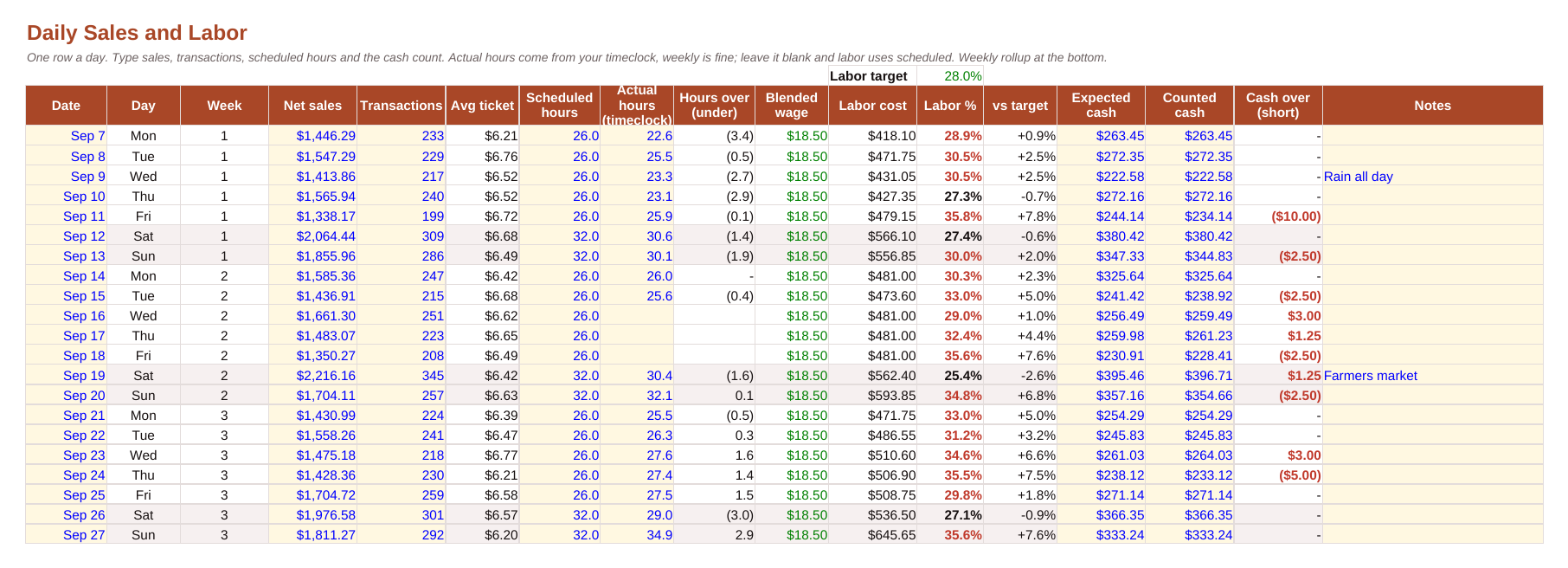
The kit's Schedule workbook prices the schedule while you write it. Type start and end times for each person, and it shows hours, overtime, labor with burden, labor percent and the dollars over or under budget for each day, plus who is on the floor each hour. It is part of the Tillwhistle kit, $97 once.