What you need
Last week's net sales for each day, from your POS. Last week's hours for each day, from your timeclock. Your average hourly wage, including anyone on salary who works the floor.
Step 1. Your labor percent for the week
Labor cost divided by net sales. In the sample shop's third week, 198.2 hours at $18.50 came to $3,666.70, on $11,385.36 in sales. That is 32.2%.
Step 2. Compare it with your target
The shop's target is 28%. At 28%, labor on those sales would have been $3,187.90. It was $478.80 more. Every week like that costs about $25,000 over a year.
Step 3. Find the days
| Day | Sales | Hours scheduled | Hours worked | Labor % |
|---|---|---|---|---|
| Mon | $1,430.99 | 26 | 25.5 | 33.0% |
| Tue | $1,558.26 | 26 | 26.3 | 31.2% |
| Wed | $1,475.18 | 26 | 27.6 | 34.6% |
| Thu | $1,428.36 | 26 | 27.4 | 35.5% |
| Fri | $1,704.72 | 26 | 27.5 | 29.8% |
| Sat | $1,976.58 | 32 | 29.0 | 27.1% |
| Sun | $1,811.27 | 32 | 34.9 | 35.6% |
Thursday and Sunday ran over 35%. Only Saturday came in under the target. Sunday also ran 2.9 hours past the schedule.
Step 4. Check the schedule itself
This is the bigger finding. The schedule as written was 194 hours, or $3,589 at $18.50. That is 31.5% of the week's sales before anyone stayed late. To hit 28% on $11,385, the week needed about 172 hours. The schedule was built for a busier shop.
Step 5. Write down one change
Pick one thing for next week and write it down. For this shop: take an hour off the Thursday and Sunday closing shifts, and have closers clock out when the closing list is done. Next Monday, check whether the number moved.
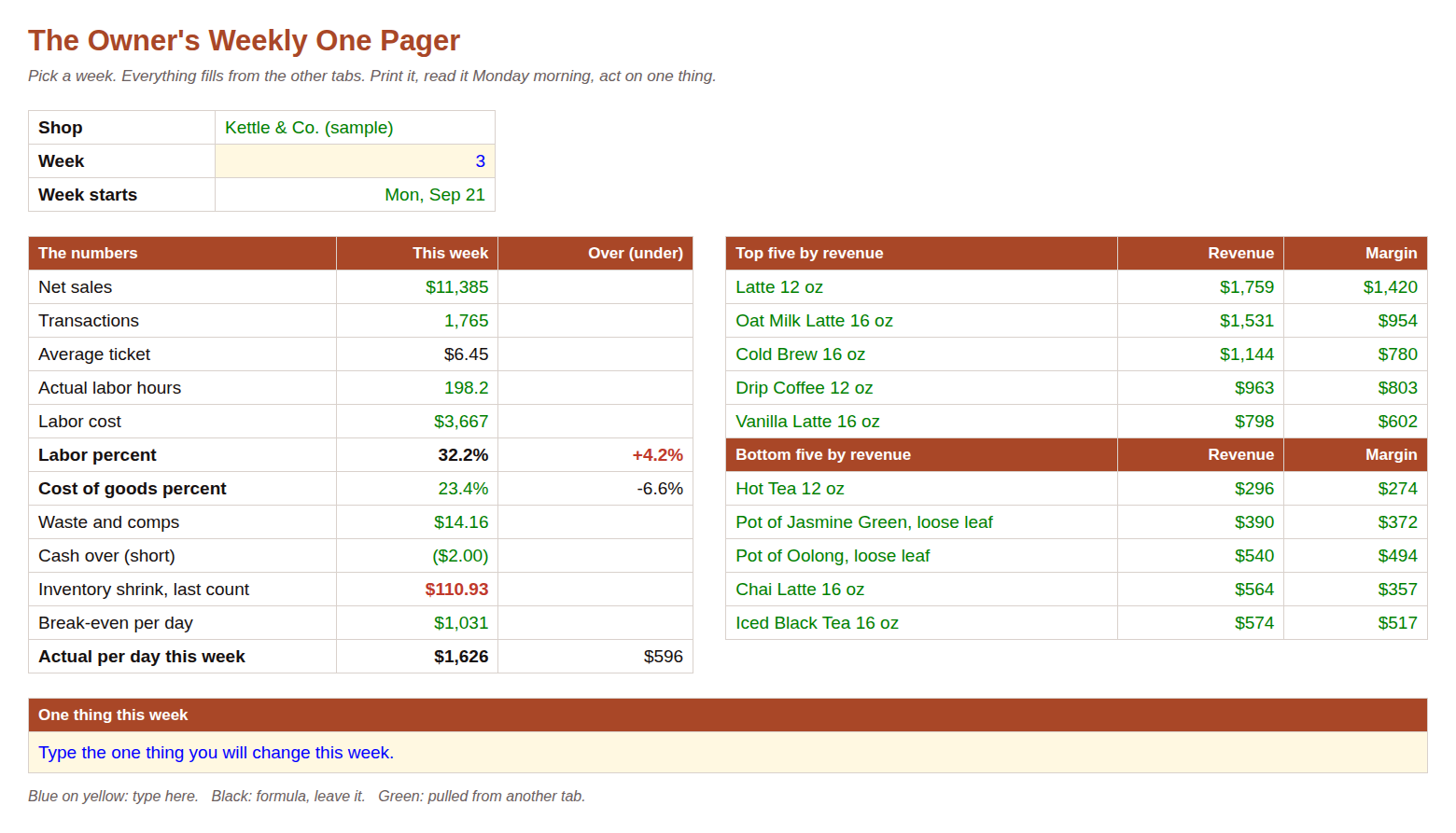
In the kit, you type each day's sales and hours into the Daily Sales and Labor sheet, about five minutes a night. By Monday the numbers are done: labor percent by day and by week, the dollars over target, and a one-page summary of the week. The Schedule workbook shows each day's labor percent while you build next week's schedule. Tillwhistle kit, $97 once.