1. List what you pay with the doors shut
Fixed costs are the bills that come every month whether or not anyone walks in. The sample shop:
| Fixed cost | Per month |
|---|---|
| Rent | $4,200 |
| Salaried manager, with taxes | $5,400 |
| Loan or lease payment | $900 |
| Utilities | $650 |
| Insurance | $310 |
| Other fixed | $300 |
| POS, software, subscriptions | $240 |
| Phone and internet | $160 |
| Marketing | $150 |
| Total | $12,310 |
Rent is about a third of it. Ask the landlord what else the lease adds each month, such as common area charges, taxes or upkeep you pay, and put those on this list too.
2. Find what each dollar of sales leaves you
Some costs rise and fall with every sale. In the sample shop, cost of goods is 30% of sales, hourly labor is 28% and card processing is 2.6%. Together that is 60.6%, so 39.4 cents of each dollar is left to pay the fixed costs.
28 to 34 percent is a common cost of goods range for drinks-led shops. Salaried pay sits in fixed costs, so it is not counted again in hourly labor.
3. Turn it into sales per open day
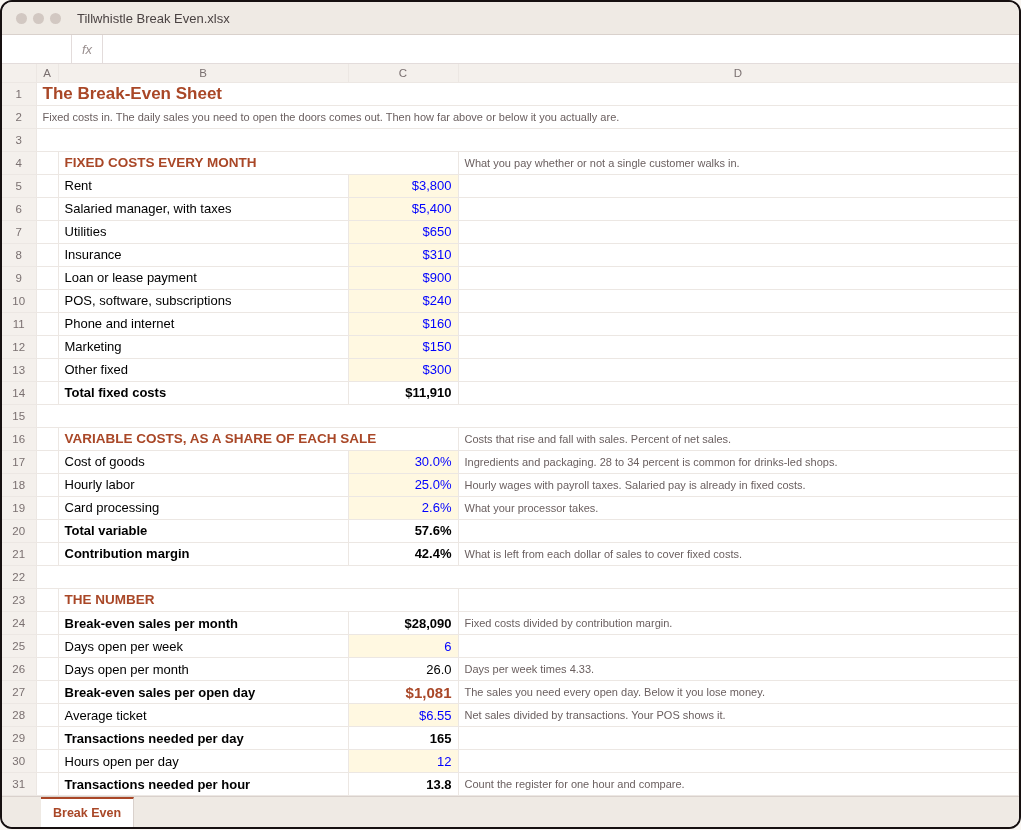
Divide the fixed costs by what each dollar leaves: $12,310 divided by 0.394 is $31,244 a month. Open six days a week is about 26 days a month, so the sample shop needs $1,203 every open day just to break even.
| Step | Sample shop |
|---|---|
| Fixed costs per month | $12,310 |
| Left from each dollar of sales | 39.4 cents |
| Break-even sales per month | $31,244 |
| Open days per month (6 a week) | 25.98 |
| Break-even sales per open day | $1,203 |
| Average ticket | $6.55 |
| Transactions per open day | 184 |
| Transactions per hour, 12 hours open | 15.3 |
Then take the number to the street. Stand near the space at the hours you expect to be busiest and ask whether about 15 people an hour buying something there sounds likely.
4. See what one change does
Each line moves one thing and holds the rest.
| If you change | Break-even per open day | Difference per day |
|---|---|---|
| Nothing (the sample) | $1,203 | |
| Cost of goods 2 points lower | $1,145 | $58 less |
| Hourly labor 3 points lower | $1,118 | $85 less |
| Fixed costs $300 a month lower | $1,173 | $29 less |
| One more open day a week | $1,031 | $172 less |
Rent is the one line you can only change before you sign. Every $300 a month off the rent takes $29 a day off break-even for the whole lease.
5. What a latte costs to make, late 2026
Arabica coffee futures traded near $2.77 a pound on November 5, 2026, about 30% lower than a year earlier. Most cafes pay about $10 to $14 a pound for wholesale roasted coffee. Whole milk averaged $4.11 a gallon in U.S. stores in September 2026, according to the Bureau of Labor Statistics.
| A 12 oz latte, to go | Amount | Cost |
|---|---|---|
| Espresso, double shot | 18 g at $12 a pound | $0.48 |
| Whole milk | 10 oz at $4.11 a gallon | $0.32 |
| Cup, lid and sleeve | One set, an estimate | $0.20 |
| Total | $1.00 |
At $5.25 that latte costs 19% of its price before syrups and waste. Pastries, syrups, waste and comps usually pull a whole shop up toward the 28 to 34 percent range. Your real numbers come from your own invoices once you open.
Our guide to drink cost shows how to cost every drink on the menu.
6. Five questions for your roaster before you sign
A roaster that helps open cafes has seen many first years. Ask before you sign the lease, not after.
| Ask | Why it matters |
|---|---|
| What is the price per pound, and how often does it change? | It sets most of your espresso cost. |
| Is there a minimum order or a contract length? | It is a monthly promise, like rent. |
| Is equipment included, leased or sold? | A lease payment is a fixed cost. |
| What training comes with the account, and for how long? | Training hours are paid hours. |
| Will you look at my break-even numbers with me? | A second set of eyes before the biggest promise. |
The free break-even sheet runs this math on your own numbers: fixed costs and percentages in, sales per open day and per hour out, with the what-if table. Once you open, the Tillwhistle kit tracks the rest every week, $97 once.